Friday, February 11, 2011

A Restorative Day Trip

Dear Devon,

The New York Times and various friends have relayed stories and photographs of trials by snow, rain, and cold. Images of slushy puddles and cars trapped in the snow only strengthen my resolve that winter does not have to be this way. There are places where winter is indistinguishable from fall or spring, and that suits me just fine.

Locals say this winter has been unseasonably cold. Two weeks of temperatures in the low 30’s hardly seem a hardship, but this city has only had one day of snow in 10 years. Sitting in the glow of the fading sun, I am completely secure in my decision to run away from New York, at least for a bit.


Friends of ours, tired of a dreary East Coast winter, decided to take advantage of our restorative locale and made the seven-hour journey over the Atlantic for an all too brief visit. They requested two things: fresh seafood and the beach. Though some leather- skinned locals have already started prancing around in the sand, at this time of year, a gust of sea breeze gives me goosebumps, so I suggest shoeless walks in the surf, clothes on.

We boarded an early morning train and made the short coastal trip to the lovely seaside resort town of Sitges. Standing on the platform in Sitges, the train continuing on its way to Tarragona, my shoulders relaxed as I drew in the crisp salty air. Sitges lay before us, bathed in the early morning glow of the Mediterranean sun. We quickly shed our Barcelona layers of hats, coats, and scarves and followed the promising sound of lapping waves. After an hour of strolling the beach, my pocket was full of shells. I was calm, a bit sun-kissed, and scouting out my lunch options.

Lunch happened on the boardwalk, under the shade of a sprawling canvas umbrella and in the company of idle old men and their sun-worshipping dogs. We feasted on local specialties, including thick slices of bread with tomato puree and Sitges’ classic salad of olives, brined codfish, and tomatoes. Next came a giant black pot of steamed mussels and clams in a garlicky, olive oil rich broth. Fervent discussion about seafood safety proliferated, as the boys eager to indulge in all the wonders of the Mediterranean insisted on prying open the tightly-closed clams. (Don’t worry, Mom, the girls won that battle). The entire meal was capped with a 24-inch pan of squid ink fideuà, a paella-like dish made with thin noodles. Purplish-black, peppered with baby squids, sticky and delicious, the fideuà left dark rings on our lips, stained our fingertips, and smudged the tablecloth. By the time lunch was over, we had drained a bottle of red wine mixed with two bottles of soda water.

Back in my apartment in Barcelona, even I have to return to reality, but this lunch memory will remain long after my tongue returns to its normal color.

Monday, February 7, 2011

Veal Chop with Wild Mushrooms


Dear Devon,

I traded you Alice Waters for Patricia Wells. With the number of cookbooks published every year, I am surprised that trading cards of superstar chefs have not yet been included in every issue of Saveur. Cookbook trading, or borrowing, in our case, is better than laminated cards.

Our cookbook swap is still affecting the way I think about food long after Patricia Wells’ Simply French returned to your library. You had dog-eared a recipe for veal chops with wild mushrooms and asparagus. In addition to Wells’ mouth watering writing and the luscious photograph on the facing page, your high regard for the recipe made me pay closer attention. I studied it and copied it down for later use.
I am not sure if it was the excitement of seeing crates of wild mushrooms, or the blood red loins of beef, but it wasn’t until I walked through the market a few weeks ago that I finally made Wells’ recipe. Of course I made some slight changes. I traded baby asparagus for leftover thin green beans and seasoned one side of each chop with herbaceous za’atar seasonings. Friends of mine brought this tasty mix back from their trip to Israel last summer, and I loved it so much I brought it to Barcelona.

My weekly meat consumption includes cold cuts and sometimes chicken, but in general, I am not a big meat eater. (I confess, I have a weakness for good hamburgers, which are a rarity over here). This was one of the best steaks I have ever eaten. The meat was perfectly cooked, pink and soft inside, but with a salty, herby thick crust. When the knife pierced the juicy meat, my mouth instantly began to water and nothing beats that satisfying crunch of a nicely crusted aromatics. The fragrant mushroom port sauce enhanced every bite, bringing out the sweet grassy undertones of the meat.

You will probably run to your bookshelf in search of her recipe. I wish I had a copy of her book here, so I could continue my dialogue with Ms. Wells. After the success of this recipe, I am eager to try more. I can’t believe I waited half a year to make this!


Veal Chop with Wild Mushrooms
Roughly adapted from Patricia Wells
(serves 2)

2 veal chops
2 tbsp za’atar seasoning
100 g wild mushrooms
2 handfuls of thin green beans
¼ cup port
1 tbsp butter

Let meat come to room temperature. Liberally salt and pepper both sides. Generously sprinkle za’atar spices on one side of meat. Gently pat into the meat. Set aside to rest for a few minutes before cooking.

Sear veal chops za’atar side up over high heat in a large sauté pan in a bit of olive oil. Once the meat has settled into the pan, avoid the temptation to touch the cooking meat. This will ensure a nice browned crust. Depending on the thickness of the meat (mine was ¾ of an inch), sear 5 to 7 minutes before flipping. Continue cooking over a medium high flame for an additional 3 to 5 minutes. I prefer my meat rare-medium rare, but I know many who prefer well done. In any event, cook the meat to your desired temperature. Remove from the pan and set aside on a warmed plate, then cover with foil or a dishtowel.

Over a medium flame, deglaze the pan with port and add the mushrooms. Gently cook the mushrooms in the reducing port sauce. Cook for five or seven minutes before adding thin green beans with their stems removed. Cook for an additional two or three minutes. Add a lump of butter and melt into the sauce.

To serve, top steak with mushroom port sauce. Serve with bread and butter and a green salad.

Tuesday, January 25, 2011

Mini Chocolate Walnut Cakes


Dear Devon,

I am not usually drawn to chocolate cakes. Sure, I enjoy the occasional bite of chocolate, and will never turn down an opened bag of peanut M&Ms, but in the end, I tend to prefer desserts without chocolate. So, it is a bit surprising that I falling into the world of chocolate obsessions.

The discovery of bricks of 70% chocolate has changed my world. Technically, the Catalans do not use this type of chocolate for baking but rather for their rich afternoon hot chocolate, usually taken with churros or melindros. Initially ignorant of this differentiation, I grabbed a bar for random snacking and occasional baking. It was a lucky mistake. Now I am embarking on a new adventure: chocolate desserts.

The chocolate is so rich that it needs something more to balance the heady chocolate flavor. I tried making this cake in a larger, traditional cake form with port-infused prunes. Delicious, but the prunes were lost in the smooth, rich chocolate flavor. Next, I tried adding grated ginger, but even 1 ½ tbsp of ginger could not stand up to this intense chocolate flavor. Perhaps the best alternative is nuts: walnuts, pistachios, or my personal favorite, hazelnuts. I set out this morning to try my theory. Will the addition of nuts bring my chocolate cake to a new level?


I was a bit too caught up in my lofty goal to make adequate preparations to ensure optimum success and low levels of stress. The truth is, no matter how large your kitchen, there is never enough counter space, the sink is full of dishes, or you need two whisks and can only find one. I was a bit frantic in the kitchen trying to pull this one together. But now, seated in front of my glowing laptop screen, chocolate cake by my side, I have almost forgotten that I splashed melted chocolate on my blue sweater and that I forgot to turn on the oven.

And even with my organizational challenges, I plan to add this recipe to my rotation. It is not a difficult recipe. It does not require an entire battery of bowls, knives, or whisks. But it does call for a bit of planning. In the end, the rich moist cake studded with creamy buttery walnuts, cloaked in the intense flavor of chocolate, will make the chore of scrubbing bowls seem insignificant.

Next on the list: Flourless Chocolate Cake


Mini Chocolate Walnut Cakes
Makes 6 small cakes or one large 9 inch cake

6 oz butter
4 oz chocolate (70% cacao)
2 eggs
1 tsp red port
¼ cup walnuts, chopped
½ tsp cinnamon
1/3 cup sugar
½ cup flour
¾ tsp baking soda
2 pinches of salt

Preheat oven to 400 degrees F. Butter and lightly flour muffin tin or cake pan. Set aside on a large baking sheet until ready to use.

Dice butter and coarsely chop chocolate. Set a heatproof bowl over a pot of simmering water. Add butter and chocolate to the bowl and gently melt, stirring occasionally to encourage even melting. Stir in port. When the mixture appears smooth and glossy, remove and set aside to cool.

Sift together flour, baking soda, cinnamon, and salt. Set aside until ready to use.

In a large bowl, whisk eggs for about 30 seconds, just to break them up. Gradually begin adding sugar, whisking vigorously until all the sugar has been incorporated. Whisk until the egg-sugar mixture is about double in volume, thick and a bit frothy. It should be a light lemon yellow color. Add flour in two additions, mixing just until the flour is incorporated. Fold in melted chocolate-butter mixture and 2/3 of the chopped walnuts.

Spoon batter into prepared pan. Sprinkle with remaining chopped nuts. Bake in pre-heated oven for 30 to 35 minutes or until a toothpick or cake tester inserted into the center comes out clean. Cool on a wire rack before serving.

Thursday, January 13, 2011

Botifarra and Onion Marmelade

Dear Devon,

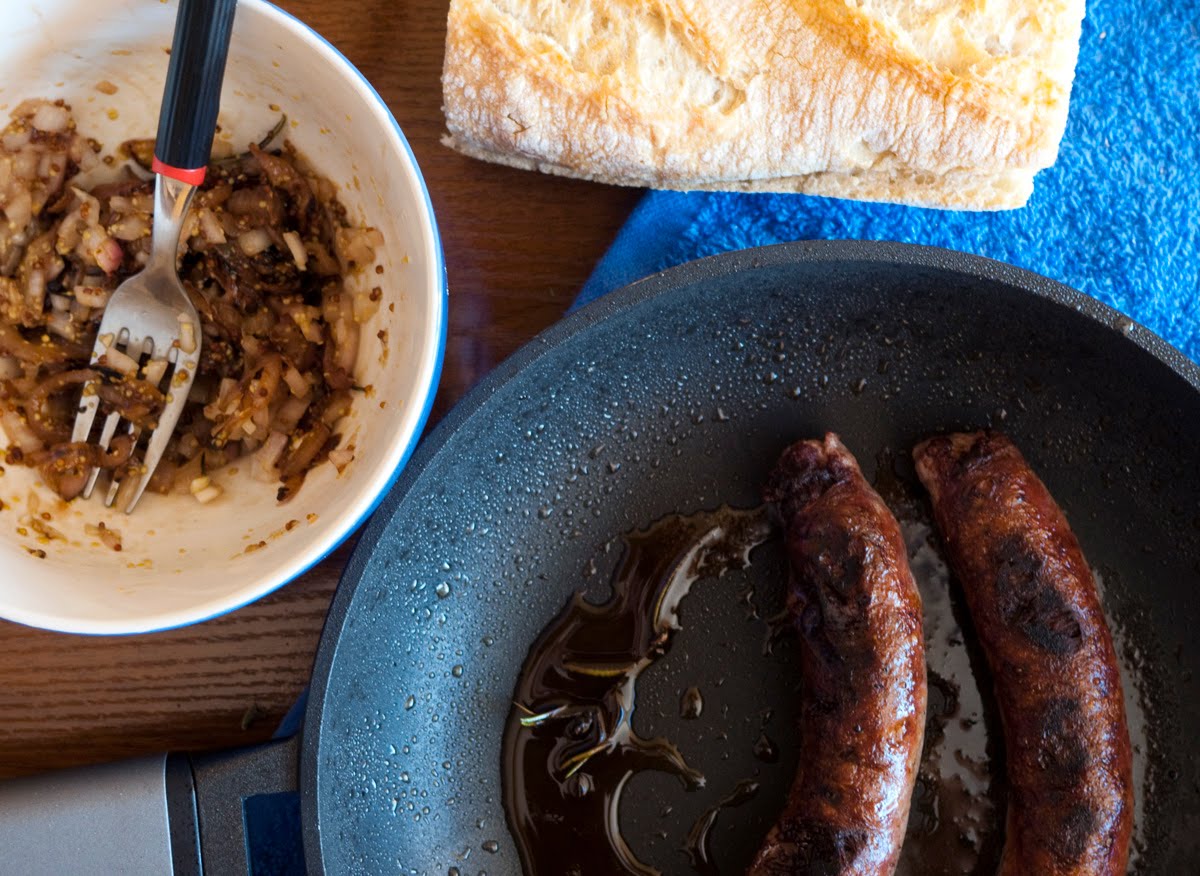
In early December, the Wall Street Journal published an article on botifarra, a traditional Catalan sausage made of ground pork and simply seasoned with salt and pepper. I was not surprised to see botifarra appear front and center on WSJ’s food page. I have been enjoying its rich and meaty flavor for weeks. One bite of this subtly seasoned sausage laced with black truffles will send anyone running to the butcher for more. I am especially fond of botifarra incorporated into tomato sauces or slowly braised with shredded cabbage. But my recent obsession has been in the form of a lunchtime sandwich. I pan fry the botifarra in a bit of olive oil. The links satisfyingly crackle and sizzled on the hot pan, the ends curl, and the skins crisp up nicely.


Found in every meat stall and butcher shop in Barcelona, botifarra at its most basic form is a lean pork sausage, without any of the trappings of luxury. Beyond this, the flavors are limitless ranging from the expected: wild mushroom, eggplant or basil to the wildly adventurous like pizza or chocolate flavors. It comes in four types: fresh, white (made with eggs), a black blood variety, and offal. I prefer fresh or botifarra blanca.

A sausage this good calls for a worthy condiment, something beyond bright yellow mustard or vinegary ketchup. I whipped up a quick dressing that I dubbed caramelized onion marmalade. It consists of sweet, golden caramelized onions mixed with fresh, crunchy diced red onions, a touch of spicy Dijon mustard, a splash of balsamic and a drizzle of olive oil. This marmalade was inspired by some of your creamy and tangy mustard sauces of lunches past.


Baguettes were sliced and toasted and smeared with a generous mound of onion marmalade. For “nutritional” value, I added a few pieces of leafy greens. The just-cooked through botifarra was eased on top, tucked into the lettuce and onions and topped by a second piece of toasted baguette.

For both our sakes, I will forgo tasting details. It would be too tortuous. Let’s suffice it to say that I will be enjoying this for lunch again soon.


Onion Marmalade
1 medium-sized red onion, thinly sliced
¼ cup red onion, small dice
2 sprigs rosemary
1 tbsp olive oil
3 tbsp port wine
1 ½ tbsp Dijon mustard
1 tsp balsamic vinegar
1 tbsp olive oil

2 sausage links (botifarra, if you can find it)
1 large baguette
lettuce

In a medium-sized skillet, heat 1 tbsp of oil. Add onions and rosemary sprigs and turn heat to low and slowly carmelize onions, 15-20 minutes. Throughout the carmelization process, add a touch of port to the onions to prevent scorching. When the onions are evenly browned, take off the burner and allow to cool.

While the onions are cooling, finely dice red onion, place into a medium sized mixing bowl. Add cooled carmelized onions, Dijon mustard, balsamic vinegar and olive oil. Mix thoroughly. Set aside for 10 minutes before serving.

In a non-stick skillet over high heat, cook sausage, roughly 7-10 minutes. The skin should bubble up and be a bit charred.

Halve baguette. Using a serrated knife, slice lengthwise. Spread a generous spoon of onion marmalade onto the bottom slice of each halved baguette. Top with lettuce and sausage. Place remaining slice of bread on top to close the sandwich.

Tuesday, January 11, 2011

Eggs over Bacon-Infused Croutons

Dear Devon,

If you haven’t already guessed, one of my biggest anxieties is an empty kitchen. Normally, my kitchen is never in such a barebones state that this should be a worry, but a fridge without eggs or milk is empty by my standards. Given the Spanish penchant for holidays, I am never sure when the market will be opened or closed. I had planned a short midweek vacation before the holidays. I did a whole round of grocery shopping before leaving just to be safe.


My list included fresh bread. Nothing beats the smell or taste of fresh bread. But, unfortunately, it has drawbacks, namely preservation. Generally, this is not a problem, but this time I was gone for three days, leaving my bread on the counter. I returned home to a rock hard loaf. I now understand how recipes like bread pudding, croutons, and panzanella originated.

I pulled together a quick breakfast, by frying cubes of the hardened bread in a bit of bacon-infused olive oil. Onions and rosemary were tossed in for some extra flavor and a bit of warmth. Crispy fried eggs topped this savory mountain of old bread. I was careful to keep the yolk loose. I wanted the broken, gooey yolks to ooze into the crannies of the hardened bread. It’s a little messy but definitely worth the clean up.


Eggs over Bacon-Infused Croutons
(serves 2)

½ loaf of stale bread
2 slices of thick bacon
1 small onion, sliced
1 sprig dried rosemary
1/3 cup to ½ cup olive oil
2 eggs

With a heavy knife, dice hard bread. Be careful with your fingers. I found cutting through the bread a bit scary. Fry chopped bacon in a sauté pan. Remove the browned pieces of bacon from the pan and set aside. Add a touch more olive oil, about ¼ cup of fat, including bacon fat. Gently fry cubed bread in oil. Sprinkle in dried, crushed rosemary leaves. Drizzle with olive oil as the bread cooks to encourage even browning and flavoring. The bread will soften as it soaks up the fat and eventually begin to toast up into crunchy morsels. Add sliced onion and cook until translucent. At the end, toss in the bacon. Remove the entire mixture to an awaiting bowl. In the same pan, fry eggs sunny side up.

To serve, scoop out a generous spoonfuls of toasted bread mixture onto a plate or bowl.

Note: I avoided salting this dish, as the bacon is already quite salty.

Saturday, December 25, 2010

Embotits de Nadal/Baby Romaine Salad


Dear Devon,

Happy December 25th! I am picturing you standing next to a Douglass fir decorated with glistening ornaments and holding a warm mug of eggnog. Most likely, you are busy organizing your Christmas feast. Tell me what’s on the menu! Does it involve roasted goose baked in puff pastry, coquille St. Jacques, or tarte tatin? My Christmas preparations will be decidedly less involved and downright low-key. Though miles away from friends and family, I am not without holiday spirit. Barcelona greeted me this morning awash in warm golden light. The damp air of stormy days earlier this week has vanished. After a quick lunch of embotit de Nadal, a local Christmas treat, I plan to lace up my sneakers for a long stroll through the old city.

I have committed the butcher’s case of cured hams, fresh botifarras, cheeses, and pork loins to memory. When something new appears, I ask questions. I am gradually developing a relationship with the energetic ladies behind the counter. Patient, high spirited, and not the least bit squeamish, these ladies have schooled me in everything from chicharrones to the difference between chops and ribs (in Spanish, of course). So it was with equal enthusiasm that the secrets of embotits de Nadal were explained.

Embotit de Nadal is a Christmas terrine, similar in shape, texture, and appearance to a French jambon persillé, only without the parsley. A jellied meat made from ham hocks and shanks, embotit de Nadal is boiled in rectangular loaf pans and cut into quarter inch slices. Hardboiled eggs, pistachios, and black olives are embedded in the loaf, which is also liberally seasoned with salt and black pepper. I bought six slices at a whopping 10 Euros. Instead of Christmas goose, I will feast on Christmas cold cuts.

Though the lady behind the counter gave me some idea of how to enjoy embotits de Nadal, I was still a bit apprehensive. I relied on past lunches in France for guidance, where jambon persillé was often paired with a fresh green salad, pickled pearl onions, and gerkins. The meat has a wonderful texture, not at all rubbery, but soft and supple. The pistachios and olives add a nice combination of salt and fruit. I prepared this Christmas treat with a big fresh salad of baby Romaine lettuce and prunes. The salad was dressed with a light infusion of egg yolk, mustard, and olive oil, and flavored with raw onions and crushed garlic. The salad highlighted the sweet meat of the embotits de Nadal with its crisp and light blend of tender Romaine, rich dressing, and wine-like prunes.

Like most Catalan food, the embotit de Nadal probably has humble roots, originating in peasant celebrations of the Christmas feast with the enthusiastic slaughter of a communal pig. After the choicest parts were tended to, the less tender or desirable cuts of meat were incorporated into a multitude of dishes. Catalan cuisine uses every part of the animal: It is an amazingly economical cuisine. This simple boiled meat is made luxurious with the addition of highly perishable ingredients: eggs, pistachios, and olives. Unlike the silky cured jamon, the shelf-life probably hovers at around a week, if you can keep your hands off it.

In the United States, jellied meat conjures images of over-salted meat sliding from a can. It is a shame that we did not develop the broad range of offerings found in European charcuteries. I am eager to see if a new generation of butchers will change this tradition.

As of now, I am happy to buy embotit de Nadal at the market. Recipes exist but I am neither brave enough nor have a pot large enough to attempt such a gastronomic feat. I leave you with a simple recipe for my delicious baby Romaine lettuce salad. It doesn’t have to be paired with a grandiose entrée. It can be enjoyed from its serving bowl in front of the television.


Baby Romaine Lettuce Salad
(serves 4)

1 ½ heads of baby romaine lettuce
½ lemon, juiced
1 clove of garlic, crushed
1/3 cup finely diced red onion
2 tsp mustard
2 tsp honey
1 egg, hardboiled
¾ cup olive oil
3 prunes

Place diced onion and crushed garlic into salad bowl. Add lemon juice and allow to rest for about 10 minutes. Macerating the garlic and onion in acid will take some of the raw out. Mix in honey and mustard. Slice egg in half and remove the yolk. Using the back of a fork, crush the yolk into the onion-mustard mixture until you form a rough paste. Whisk in olive oil. Season with salt and pepper. Test for acidity and add more oil as needed.

Slice baby romaine lettuce in half lengthwise. Remove the core and slice in half again. Cut into rough chunks. Roughly chop egg white and prunes. Add lettuce, egg white and prunes to the dressing and toss.

Wednesday, December 15, 2010

Pearl Onion and Haricot Vert Frittatina


Dear Devon,

I read a lot of cookbooks, food blogs, and food sections of various major newspapers. You could say I read a lot of recipes and even more opinions about food. But what happens when you abandon the written word for intuition and casual cooking? The answer is kitchen magic and a darned good meal.

Thomas Keller’s recipe for creamed pearl onions has been swimming around in my head. In the past, I never bothered with pearl onions. The tedium of removing skins from onions smaller than gumballs was enough to make me shelve any thoughts of pearl onions. I must have been in a good mood, because today it didn’t seem like that big a deal.

Waiting for my turn at the grocer, I saw a rectangular box, neatly packed with short, matchstick-thin green beans. I always go to the market with a rough shopping list. There is always room for unusual or seasonal fruits that might catch my eye. In this case, I decided on the spur of the moment that these unimposing legumes would pair nicely with butter braised pearl onions.

My loose dinner plan centered on leftovers with a side dish of braised pearl onions and legumes. However, as the temperature in the apartment was on the chilly side, there was a request for something that required oven cooking. I abandoned my plan and converted my braised veggies into a quick frittata. The addition of four eggs and a splash of milk transformed this aromatic side into a rustic main course.


Measuring just short of an inch thick, I dubbed it a frittatina. Tucked into their egg blanket, the fat pearl onions charmed me. Hard crackers served as our carbohydrate for the meal. The wheat based crackers, crunchy and inflected with the earthy taste of unrefined grain, made a nice contrast to the succulent pearl onions and the creaminess of the eggs.

While I love following a battle-tested recipe, it is always reassuring to know that some of the most satisfying meals do not require the consultation of long texts, complicated techniques, or unusual ingredients.


Pearl Onion and Haricot Vert Frittatina
(serves 2 comfortably)

½ cup pearl onions, roughly 16 onions
about 30 thin haricots verts
4 eggs
¼ cup milk
½ tbsp butter
1 sprig rosemary
shaved parmesan cheese

Preheat oven to 400 degrees. Set the oven rack in the middle of the oven.

Bring a large pot of water to bowl. Prepare a large bowl of ice water. Using a sharp knife, remove the ends of the haricots verts. Add pearl onions to boiling water and cook for about two minutes. Add haricots verts to the boiling water and onions. Cook for one minute more. Remove onions and haricots verts and quickly dunk into icy water. Let sit for thirty seconds to one minute. Strain and remove haricots verts to an awaiting bowl. Carefully slip the brown skins off the onions to reveal the opaque white flesh. Set aside in a separate bowl.

In a medium-sized nonstick pan, melt butter. Strip leaves from rosemary and add to melting butter. The entire kitchen will start to smell of nutty butter and fragrant rosemary. When the butter begins to brown, add the skinned pearl onions. Braise over a low flame for approximately 10 minutes, until the onions are nicely browned and slightly golden. Add haricots verts, cooking for an additional two to three minutes, just to give the greens a touch of color.

In a separate bowl, beat eggs with milk and two large pinches of salt. Pour beaten eggs into the skillet of browned onions and haricots verts. Gently cook the eggs for three minutes over a low flame. Place in the oven to continue cooking. Bake for approximately 7 to 10 minutes or until the top is nicely browned and the eggs have just set. Be careful not to overcook, as this will produce a rubbery texture. With a vegetable peeler, shave large ribbons of parmesan cheese directly over the hot frittatina.

Friday, December 10, 2010

Aromatic Purple PlumSalad


Dear Devon,

Does fruit salad need a recipe? Certain combinations go extremely well together: Who would turn down strawberries and cantaloupe, or blackberries and peaches? Fresh and ripe, they are great combinations. But often, fruit salad collapses into browned and mushy fruit in a bowl. Peaches, strawberries, and bananas bruise easily, and on a sunny day, the fruit begins to macerate, great for jams but not ideal for fruit salad. For these reasons, I usually avoid making fruit salads.

Before leaving for Barcelona, I spent my last weekend wandering around Williamsburg. A friend brought me to Radish on Bedford Ave. The quaint shop is styled after an oldtime general store, decorated with eccentric hand-painted chalkboards and a beautiful antique lead-lined fridge. Radish pushes the phrase “take out” way beyond pizza, falafal pitas, or supermarket sushi. It’s real food, cooked using locally grown ingredients. Dishes are kept warm in stylish Staub cocottes and set beside gleaming white trays of savory side dishes. Everything looked absolutely delicious, but alas, we had just stuffed ourselves silly at Fada.


A fruit salad marked as “purple apricot, red onion, and mint” intrigued me. My experience with purple apricots is extremely limited, or rather, nonexistent. I have never seen a purple apricot, so I’m not even sure that’s what they really were. At first glance, they looked like plums. Either way, I was taken with the idea of adding spicy red onion to a sweet fruit salad. I went to the market that afternoon to try it for myself.

Radish was right. Purple onion mixed with fruit is an inspired combination. The flavor is a bit unfamiliar, but definitely not disgusting or off-putting. I sliced fresh purple plums into big wedges and added halved figs. Next came the onion, in thin slivers, opaque, crisp, and fragrant. The salad was carefully tossed with a wooden spoon, gentle on the delicate fruit. The final touch was a bit of aromatic: Lemon zest, mint, or rosemary, on other occasions.


The final salad smells spicy and flowery. It looks amazing with tiny ribbons of red onion settling onto the juicy wedges of plum and plump figs. This salad is about contrasts: Spicy, crisp raw bit of red onion paired with sweet, tangy plums and the grittiness of fig.

Don’t judge this salad until you’ve tasted it. It does require a bit of faith. Pairing red onion with plums and figs is not typical, but I guarantee that it will change how you think about the fruit salad.


Aromatic Purple Plum Salad
(makes 2 servings)

1 large purple skinned plum, sliced
4 figs, halved
2 sprigs rosemary, chopped (about ½ tsp)
1 tbsp red onion, thinly sliced

Wash figs and plums. Dry thoroughly. Cut plums into wedges (a large plum can give you 12 wedges). Halve figs. Store in a large bowl and set aside. Using a very sharp knife, cut paper-thin slices from a medium-sized red onion. Remove leaves from rosemary sprigs and finely chop. Sprinkle fruit with red onion and rosemary. With a large wooden spoon, gently mix the salad. Set aside for 5-10 minutes to allow the flavors to set.