Sunday, May 29, 2011

Tarte Au Citron

Dear Devon

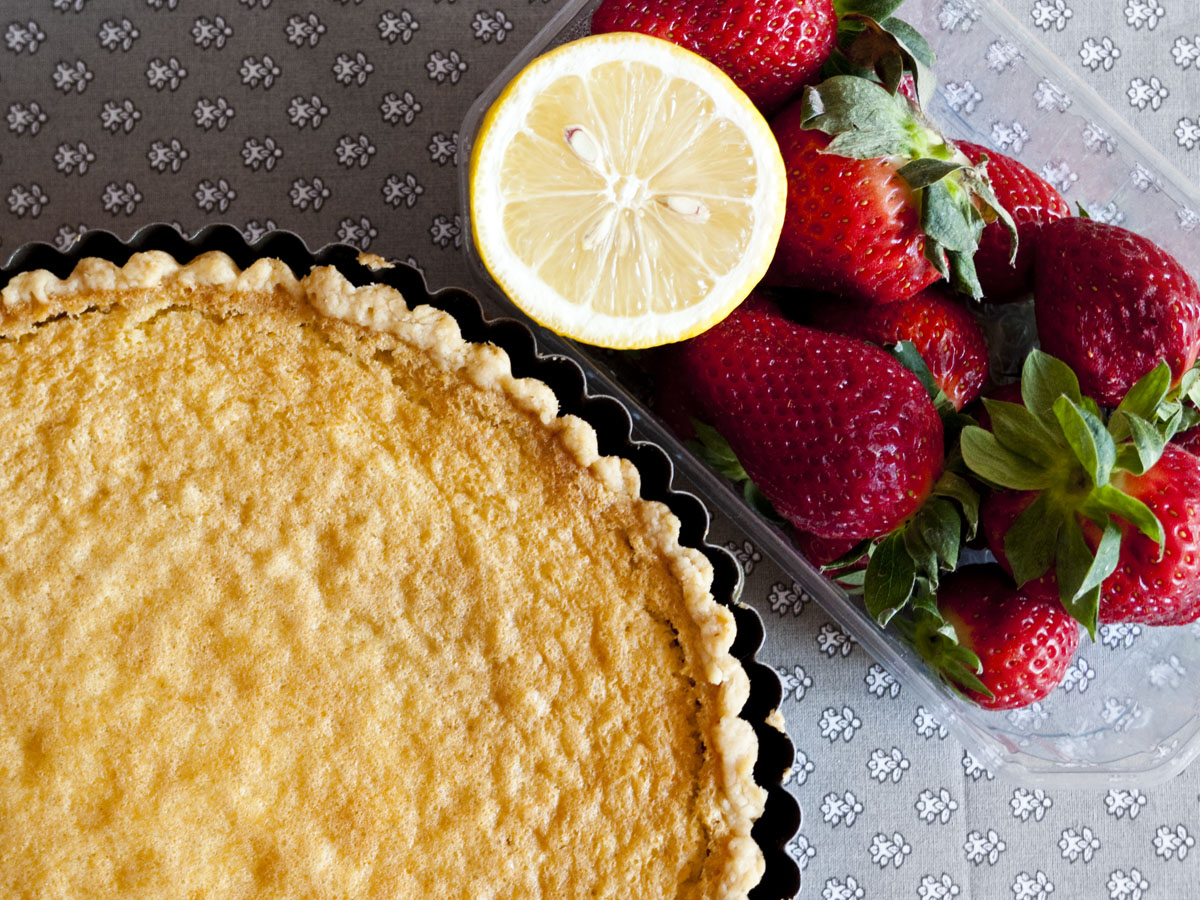
Hands down, Anne Willan’s recipe for tarte au citron is the best. One of my all time favorite desserts, tarte au citron is one of late afternoon, last minute desserts. I have experimented with graham cracker crumb crusts, whizzed whole oranges with sugar in food processors, and topped pale yellow tartes with fresh raspberries. Julia Child, Dorie Greenspan, Patricia Wells, Ina Garten, all have their tarte au citron recipes (which I have meticulously ranked), but Anne Willan’s recipe recently catapulted to the top.

A few weeks back, I hosted a small dinner party. The menu included a creamy blanquette de veau, simple garden salad, and two desserts: tarte au citron and a lovely fruit-topped, whipped cream laden cake from the pastry shop. Dinner was followed by an all night marathon of friendly poker, after which that wonderful cake was a welcome sight. It was a great evening and reminded me of why I love hosting dinner parties. I have a chance to serve a variety of recipes that would otherwise remain in black and white print.

Except for one adjustment, I followed her recipe exactly. The recipe called for ¾ cup almond flour. I’m still not so good with the numbers, so I ordered too small a bag from the dry goods stand. So, I added dried coconut to equal the full ¾ cup. The coconut was a nice addition, subtly balancing the tartness of the lemon filling. However, the biggest surprise was the call for pulverized almond instead of cream. I was a bit hesitant at first, but am now a firm believer in almond flour over cream in all tarte au citron recipes. The tart had a nice light texture and held its shape nicely after each slice. I will never go back to cream, when almond flour can be substituted.

Whipping the egg and lemon juice to the ribbon stage nearly killed me. My shoulder muscle is cramping as I type. I have a new respect for those pre-KitchenAid chefs. I have temporarily shelved an attempt at chocolate mousse in favor of the less labor-intensive dessert of cut fruit.

I intended to top the tarte with macerated strawberries. But at the last moment, I opted to serve the berries at the end as a finishing course. The tarte is so good, that it doesn’t need further embellishments. It is a stand alone dessert.

Pull your copy of The Country Cooking of France from your shelf and try it. I’m dying to hear your thoughts, but please use your electric beater.

Tarte Au Citron
(serves 8)

Pate a Sucre
I used Julia Child’s recipe from Mastering the Art of French Cooking.

Lemon Filling
½ cup ground almonds
¼ cup shredded coconut
3 /4 cup granulated sugar
3 eggs
grated zest of 2 lemons
¼ cup lemon juice
2/3 cup butter melted

Prepare pate a sucre according to Julia Child’s recipe from Mastering the Art of French Cooking.

Blind bake the tart shell until light golden brown.

For the filling, beat eggs and sugar until the mixture until thick and pale yellow. The mixture should leave a ribbon trail when the whisk is lifted. Stir in the lemon zest, lemon juice, and butter. Stir in the ground almonds and the coconut.

Set the tart shell on a hot baking sheet and pour in the filling. Bake until set and golden brown, 25 to 30 minutes. Let cool on a wire rack before unmolding. Serve at room temperature.

Thursday, May 26, 2011

Pan Roasted Zucchini Sandwiches

Dear Devon,

I can’t believe a whole month has passed since I last wrote. As of late March, my life has been busy with visits from friends and family, all eager to enjoy the sunshine, fresh seafood, and explore the streets of Barcelona. And then there was all the travel: Two trips to Madrid, a weeklong stay in Andalucia, and a short daytrip to Montserrat.

Renee came out for a month long visit, took a week of Spanish classes, and was a willing traveling companion. She organized a short trip to Madrid, which included a visit to the Royal Palace, Sunday morning rambling at El Rastro (the biggest flea market in the world), and an afternoon at the Prado Museum. In between those stops, I dragged her through the streets of Madrid, scouting out churches, convents, and… restaurants. If you are vegetarian, Madrid isn’t the friendliest of cities, but if you love pork, you’ve hit the jackpot. After her departure in early May, two more guests took their turns sleeping on the inflatable mattress in the living room.


Our last guest left early Monday morning. The air mattress can finally get its much- needed rest. The process of putting the house back together began this morning, with long neglected errands penciled in for the afternoon. I am easing back into my routine and gearing up for a hot, hot summer. Thanks to one of my guests, we discovered that some of the best ice cream in Barcelona is blocks from the apartment. Our brand-new, and all-too-necessary ice cube trays are cooling in the freezer, and today, the all-important fan will be broken out of its box.

Today’s lunch will also be low key. Pan roasted zucchini, fresh tomato, and Mahon cheese between slices of grilled baguette. A cow’s milk cheese from the Balearic Islands just south of Barcelona, Mahon cheese is smooth and rich with a sharp floral note. I usually serve it with a slice of crisp apple, but have found that its strong flavor complements the butter-like taste of roasted zucchini. It’s the perfect, limited prep sandwich for maximum taste.


Pan Roasted Zucchini Sandwiches
(serves 2)

One loaf of fresh baguette (or day old works nicely too)
1 zucchini, sliced lengthwise
1 tomato, sliced into generous ½ inch slices
Mahon cheese, sliced
1 garlic clove, peeled
Olive oil
Salt

Heat up a skillet with a drop of olive oil. Halve baguette and slice lengthwise. Lightly drizzle sliced bread with olive oil. When the skillet is nice and hot, set baguettes cut side down into the skillet. Slowly toast, until golden brown. Remove. Scrape the peeled garlic clove over the hot, toasted bread. Top with tomato. Place sliced cheese on the second half. Set aside. Add a drop more olive oil. Over medium heat, slowly cook sliced zucchini until golden brown. Set cooked zucchini over cheese and bread.

Thursday, April 28, 2011

Ripoll, Catalonia

Dear Devon,

As much as I love urban life, sometimes it is nice to know that an entirely different world awaits me only an hour’s drive from the city limits. In that spirit, we packed up a rental car with a few sandwich-making goodies including loaves of bread, cheese, chocolate (wait, that’s not for sandwiches), cured meats, and apples, and headed to the Pyrenees.

Fortunately, I was not pressed into service as a driver, so I lounged in the back seat, thoughts focused on the intermittently rocky and verdant scenery. Guided by an antique, but still serviceable road atlas and the most recent edition of Lonely Planet Spain (which we tried to ignore), we turned what started as a one-day excursion into a two-day affair. There was no definite plan, and no hotel reservation, no real discussion of endpoints or mealtimes.

We stopped around lunchtime in the town of Ripoll, famous for its Romanesque monastery. It was a beautiful day, so we parked at the train station, and grabbed our lunch and strolled into town. The Saturday market was in full swing. A dusty street was given over to mobile stands of hanging sausages, tubs of olives, crates of vegetables, and other sensual things that caught our attention before we could find our way to the monastic complex at the center of town.

Though we had dutifully brought our own lunches, the smell of slow roasted, herb spiced chicken at a truck parked on the market street was irresistible. For eight euros our humble sandwiches were upstaged by a piping hot roasted chicken, roughly cut by the vendor with a pair of large, and obviously very sharp scissors. Lacking utensils or napkins, we dove into our lunch. Ten minutes later, we were sitting on a bench in front of the church-museum, debating the merits of lunch versus cultural edification. Bellies full and a bit pleased with our lack of decorum, we crossed the street to the monastery, only to find the doors closed for… lunch. Undeterred, we found an empty table in the sun-filled plaza, ordered coffee, and spent two hours in relaxed conversation.

By the way, despite having been very enthusiastically restored a century ago, the monastery is worth the visit, even on non-market days.

Friday, April 22, 2011

Quiche Lorraine

Dear Devon,

Farm fresh eggs. A friend gave me a present of four eggs, real farm eggs from her grandmother’s chicken coop in a small Catalan mountain village. I’ve tried to explain the difference between American and Catalan eggs for my friends from Barcelona. I am still surprised by their natural creaminess and neon orange color. That’s when the egg-collecting grandmother entered the discussion. Her small flock of chickens lays eggs for her city living granddaughter.


In the interest of continuing my education, several eggs were carefully packed in newspaper and given to me. That’s the thing about the people here; they are exceedingly generous. If you show the slightest interest in anything, it will be insistently pressed into your hand. Refusal is not an option.


To enjoy this gift to the maximum, I dusted off the tart form and settled on Anne Willan’s decadent Quiche Lorraine recipe. Eggs, crème fraiche and lardons are the major players in this over-the-top quiche. It’s the perfect mix of creamy eggs and smoky freshly fried bacon enclosed in a flaky and buttery crust. It comes out of the oven puffed and steaming hot. Willan suggests eating it straight from the oven for maximum flavor, which we did, but we also enjoyed cold slices for breakfast the next day and the next.


Quiche Lorraine
(from Willan, Anne. The Country Cooking of France p. 46)

Pate Brisée
1 2/3 cups flour
1 egg yolk
¾ tsp salt
3 tbsp water
6 tbsp butter

Filling
1 tbsp butter
7 oz lean smoked bacon, cut into lardons
2 eggs
1 cup crème fraiche

Preheat oven to 375 degrees.

In a food processor, combine cubed, chilled butter with flour and salt. Pulse until small peas form. Add egg yolk and pulse, three or four times. Add water, tablespoon by tablespoon, pulsing the machine until the dough just comes together. The amount of water used depends on the humidity of your kitchen. You may not need to use all the water. When a rough dough forms, turn out the dough and lightly knead on a floured surface. Form into a ball and rest in a lightly oiled bowl. Cool in the fridge 15 to 30 minutes.

Roll the chilled dough to ¼ inch thick on a lightly floured surface. Line tart pan with dough. Using the tines of a fork, prick the dough all over and fill with pie weights. Bake the shell until light golden color, roughly 20 minutes. Remove from the oven and cool on a cooling rack.

For the filling, cook lardons until lightly browned and crisped. Remove from the pan using a draining spoon and cool on a plate lined with super absorbent paper towels. In a bowl, whisk together eggs and crème fraiche. Line the cooled pie shell with lardons and pour in the egg mixture. Bake until the filling is set and golden brown, 30 to 35 minutes.

Tuesday, April 19, 2011

Fira de Bellcaire, Barcelona


Dear Devon,

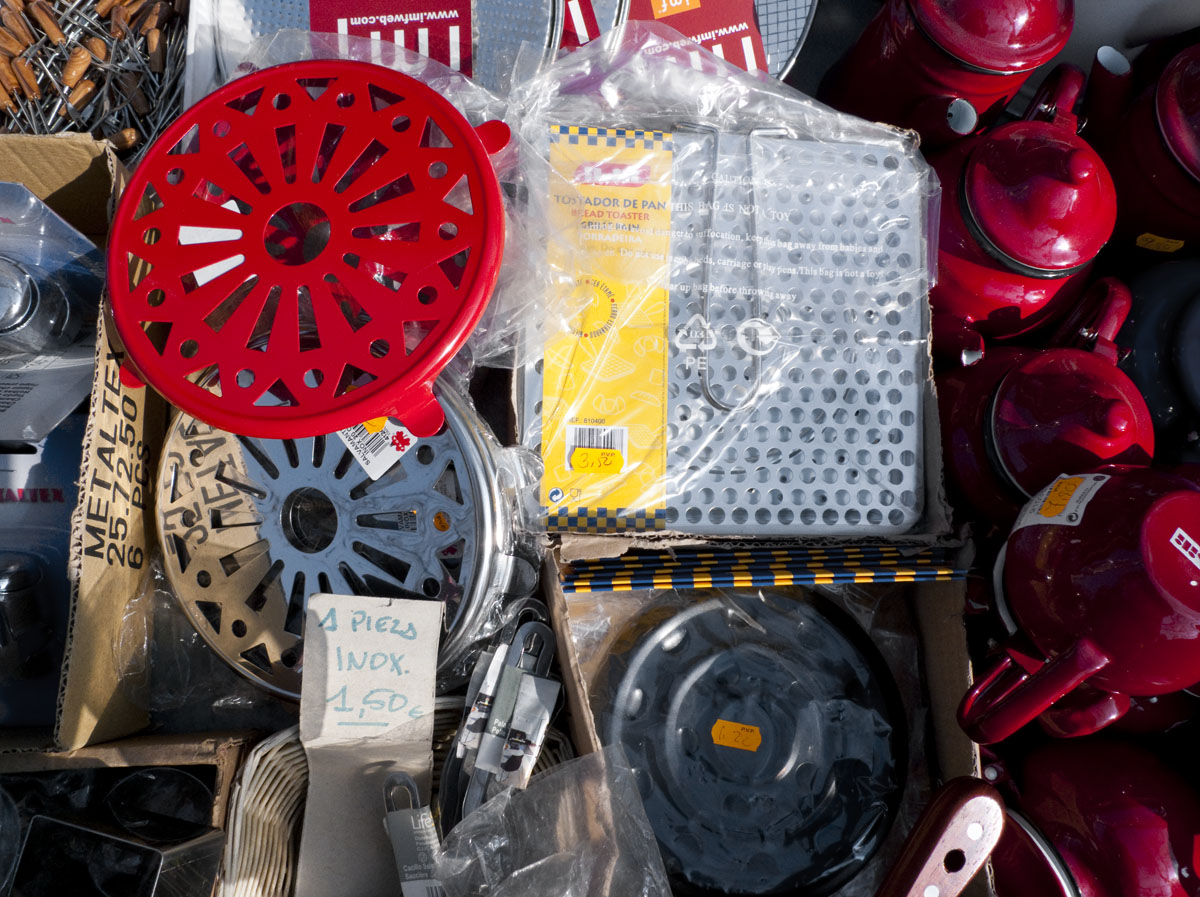
Every Monday, Wednesday, Friday, and Saturday, the calls of spirited vendors rise and fall like contrapuntal melodic lines in the Fira de Bellcaire, Barcelona’s open air flea market. I still haven’t found any rare and unrecognized masterpieces in their heaps of junk, but from time to time I feel the gravitational pull of this bustling arena. Perhaps it is the energy of the market that keeps me returning? More likely, it’s the fortuitous location, an easy fifteen-minute walk from my apartment. There is some fascinating people watching here, not to mention enough random dust-covered clutter to keep a third rate antique store fully stocked for years.

Despite my many ventures into the crowded market, I still feel a bit discombobulated every time I walk in. It’s that frenetic energy and the anticipation of hitting the jackpot. I move through the crowded aisle of ancient LPs, rusted hand tools, and yellowing photographs. I want to get to those vendors who display their wares on large plastic tarps. There you can find some potentially good stuff: chipped porcelain dishes, garish golden statues, bolts of brightly patterned fabric, and of course, carved dark wood headboards. I’ve seen people carry some crazy stuff out of the gate.

But while I enjoy the idea of the hunt, the fact is that I lack both the patience and the talent to be more than an occasional treasure hunter. In the end, I always lose interest in these makeshift stands and find myself in the friendly company of a man who sells kitchenware. Gruff, beard yellowed by an ever-present cigarette, and dressed in blue overalls, his appearance contrasts with his almost delicate, soft voice and encyclopedic knowledge of kitchen equipment. If you get him started on paella pans, you’ll be there for at least 15 minutes. Don’t misunderstand me, I am completely captivated by him and I almost never leave without purchasing something, to the annoyance of the person who will be carrying my suitcase home.

My latest purchase is a stainless steel paella pan. When my mother visited, she mentioned wanting to bring one back to the States. So we paid him a visit, but after he went through a long explanation of paella maintenance (not dishwasher safe), she decided against it. Younger, and less experienced, I purchased one. I don’t exactly regret the purchase, but taking care of the light steel pan is a bit of a pain. The pan has to be thoroughly dried and lightly coated in olive oil after every use to prevent rusting. In the end, this shouldn’t be such a problem, but I am spoiled by American no-stress cookware. I love cooking pots, gadgets, storage containers, spatulas, and wooden spoons. I just hate doing dishes!

Wednesday, March 30, 2011

Clarified Butter and Ghee


Dear Michelle-


Those eggs sounded so good that I made soft-scrambled eggs and toast for breakfast today. I added a creamy blob of butter halfway through, and some rosemary salt from The Meadow in Portland on top. It was amazing. I love the table cloth you are using in the photos of the eggs!


I've been on a diet of sorts the past two weeks or so. It's not a losing weight diet, but the cleansing sort. It is designed to be easily digestible, to reduce the amount of energy the body puts into dealing with digestion and daily elimination of toxins, which leaves more energy for eliminating built-up toxins and inflammation. Exciting, huh? Just wait! Not allowed is any grain with gluten, refined sugar, alcohol, caffeine, soy, or any animal products besides chicken meat (apparently very easy to digest--who knew?) and Indian clarified butter, ghee.


As you can see, there's not much variety called for in the diet, but it's not supposed to be about gastronomy. This was perhaps the hardest thing for me to deal with. My daily diet consisted of oatmeal with applesauce (unsweetened, organic) in the morning, and lunch and dinner were servings of kichadi, a mixture of spices with mung beans, rice, and vegetables. It wasn't so bad, and I found a spice mixture that was to my liking, but there's no way to get around that kichadi=mush. The things that made it more exciting were an allowance of chutneys and ghee. I bought a couple of chutneys, whipped up an additional easy apple-apricot-ginger chutney, and have made two batches of ghee.


I thought until recently that ghee and clarified butter were one and the same, but that's not the case. Butter is made up of three things: fat, water, and milk solids. Clarified butter is just the fat; ghee is the fat after the milk solids have toasted a little, lending to it a delicious nutty flavor and a gorgeous golden color. The advantage to using this "purified" butterfat over regular butter is that it does not burn as easily, so it can be used to impart a buttery flavor to foods in which you'd otherwise have to use oil. I don't know if this technically means that ghee has a higher smoke point than butter does, but the milk solids present in butter do burn before the oil does.


Ghee is also okay to eat for those people who are sensitive to dairy, a big treat if you have otherwise been avoiding butter. I know that there are supposedly good butter replacements out there, but let's be honest here for a minute--all things being equal, would anyone choose margarine over good, old fashioned butter?


Because the milk solids and water have been taken out, all clarified butters have a longer shelf life than regular butter does. One can see why that would be so valuable in a hot country like India, so it is not surprising that ghee has a sacred role in some Hindu rituals, as well as a hymn dedicated to it. It is much used in Ayurveda, traditional Indian medicine. 


When making clarified butter or ghee, it is important to start with organic butter. I was told once that added hormones accumulate in the fat of animals, and that was enough to keep me buying organic butter. Though I do not buy organic across the board, I am careful to only buy organic dairy, eggs, and meat. 


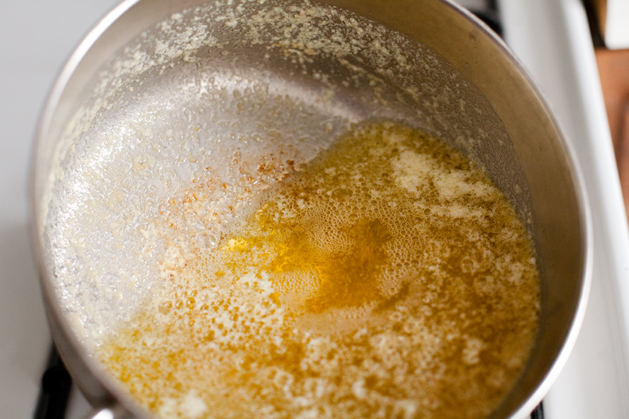
Making ghee is pretty easy. So easy, in fact, that I don't even need to write out a real recipe. Put butter in a deep pot. I used a pound, and most sites say that you'll lose about a quarter of volume in the process of cooking. Heat the pot on very low. The butter will melt, then develop film. It will pop and sputter, and fill your kitchen with a heavenly scent. The film on top becomes harder (this can be skimmed, I don't bother), and some milk solids will fall to the bottom of the pot. Once the popping and sputtering stops, about a half hour in, you have clarified butter. If you want to make ghee, watch the pot closely at this point; you want the milk solids on the bottom to brown lightly, BUT NOT TO BURN. Once browned and toasty-smelling, pull from the heat. The easiest way to decant this is to line a strainer with cheesecloth and poor through to a medium sized mason jar. This should hold indefinitely in the fridge. Below are photos of the various stages that butter goes through to clarify. I'd recommend cooking it in a large enough pot that the uncooked butter covers most of the bottom of the pot; I made some ghee recently that burned before it had stopped popping, I think because the melted butter was too shallow.


Friday, March 18, 2011

Softly Scrambled Eggs with Fava Beans

Dear Devon,

Thoughts of your celery kimchi have my mouth watering. I’m imagining a spicy, crunchy and refreshing bite soaked in a salty and tangy brine. Homemade kimchi is probably the easiest bit of “cooking” out there. I have made several batches since moving to Barcelona, calling upon local ingredients and rather inventive brining methods (fridge is small). But my next batch, will definitely involve celery.

Something else I’ve been drooling over is Anne Willan’s The Country Cooking of France. This book has become the standard by which I judge all other cookbooks. It has absolutely gorgeous photographs for almost every recipe in the book, and includes detailed instructions. Never underestimate the importance of detail when explaining how to prepare pig’s feet or soufflé techniques.
And while I consider myself fairly handy in the kitchen, her text does leave me a bit intimidated. She seduces me with recipes that seem easy to execute but conjure battle scenes with an unwieldy giant in my imagination. Am I exaggerating? You’ve known me for years and you must know that I tend to embellish.

It is time to stop reading and move towards the stove. I’m living next to some of the greatest markets and pork products in the world. I should embrace some of Willan’s more adventurous recipes. When else will I have this chance? Plus, I am lucky, my dinner guests these days are forgiving, adventurous types.

For a warm up exercise, I chose Willan’s recipe for softly scrambled eggs with wild mushrooms. If you haven’t tried softly scrambled eggs, I suggest you to crack some eggs and try it tonight. The texture is buttery and light. The trick is to scramble the eggs over low heat. It takes an extra 10 minutes or so, but is definitely worth the wait. Overflowing from every market stand when I first arrived in Barcelona, wild mushrooms have disappeared into their damp retreats until the fall. Undeterred, I substituted fresh fava beans.


Softly Scrambled Eggs with Fava Beans
Adapted from Anne Willan’s The Country Cooking of France

1 pound fava beans in the pod
1 slice of unsmoked bacon, cut into chunks
4 eggs
¼ cup milk
1 pinch salt
toasted bread

Bring a large pot of water to boil. Drop in the fava beans (in their pods). Boil roughly 5 minutes before removing from the stovetop. Drain and soak in cold water. When the beans are cool enough to handle, break open the pods and remove the beans.

In a sauté pan, slowly fry bacon. When the bacon is nice and crisp, remove from the pan and reserve in a small mixing bowl. Add the shelled fava beans to the bacon fat. Cook over medium heat until nicely browned. Remove from the pan, adding favas to the bowl with the bacon.


In a separate bowl, whisk together eggs and milk with a pinch of salt. Wait for the pan to cool down, before cooking the eggs. Turn the flame to medium-low. Add egg mixture. Using a wooden spatula, stir the eggs, scraping the sides and bottom of the pan. The goal is to prevent the eggs from setting too quickly or clumping. Vigilant stirring is the key. Cook for about 10 minutes. The eggs should be loose but not runny, without any traces of raw egg. At the last moment, stir in the favas and bacon. Freshly chopped herbs would be a nice addition. I recommend: chive, chervil, dill or parsley.

Serve over toast and with freshly grated black pepper.