Showing posts with label market. Show all posts

Tuesday, September 6, 2011

Apricot Cake

Dear Devon,

Summer, is perhaps my favorite season, not because of its relaxed balmy nights or the promise of vacations, but because of the sweet, ripe fruits. Every summer, I look forward to filling my fridge with apricots, peaches, watermelons, pears, and strawberries. Unfortunately, the fruits of recent summers resemble only in name and shape the fabulous fruits of years past. I can’t tell you the number of times that I have been disappointed by hard peaches, mealy pears, and green apricots. It always broke my heart to walk past those perfect looking but tasteless summer fruits. And, I am sure it’s going to be harder once I return from Barcelona. The fruit here is how I remember fruit from my childhood to taste, feel, and smell.

Juicy, sweet, and gently blushed, apricots are again my favorite summer fruit. Apricots come in two sizes, big and small. It is not the most sophisticated of classification systems, but it’s the best that I can get out of my fruit vendor. I’m partial to the smaller ones, which have a more intense honey-like flavor and are a bit more delicate. Alas, the season is already over for these gems; I will have to make it through with their larger counterparts.

The apricots are so tasty that I debated whether to bake with them. In the end, the temptation to experiment was too strong. I pieced together two of Dorie Greenspan’s recipes and invented an olive oil based cake flavored with lemon infused sugars and a splash of hazelnut oil. The cake turned out nicely, but it also turned me out of the apartment. Barcelona has been experiencing a mild summer, but August brought an inescapable wave of humidity, blinding sun, and scorching heat. (Every tourist wears a sunburn like a badge of honor. I am hidden under dark sunglasses, hat, and an impenetrable layer of spf 75 sunscreen). My tiny apartment is a death trap, especially with the oven on. But when perfectly ripe, juicy, fat apricots are in season, I can set aside temporary discomfort for a delicious slice of cake (or so I thought).


Apricot Cake
(makes one 9 inch round cake)

1 pound apricots, halved
¼ cup white sugar
2 lengths of lemon peel
½ cup brown sugar
9 tbsp olive oil
2 eggs
1 tsp hazelnut oil
1 ½ cup flour
½ cup cornmeal
½ tsp baking soda
½ tsp salt
½ cup milk

Preheat oven to 350 degrees F. Butter a springform pan and set aside until ready to use.

Pick over and wash apricots, cleaning off any dirt and removing any bruised portions. Using a sharp knife, halve apricots and remove the stone. Continue until all the apricots are halved and pitted. Set aside until ready to use.

Put white sugar and lemon peel in a large mixing bowl. Using your fingertips, crush the lemon peel into the sugar, infusing the white sugar with the fragrant citrus oils. Discard peel and add brown sugar. Add olive oil and mix until a thick soupy consistency. Beat in one egg at a time, followed by hazelnut oil.

In a large mixing bowl, combine flour, cornmeal, baking soda, and salt. Measure out milk. Alternating between flour mixture and milk, add to the sugar-oil batter, beginning and ending with flour.

Pour batter into prepared cake form. Nestle halved apricots into the batter, creating a roughly circular pattern.

Bake in the oven 55 to 65 minutes, until golden brown and fragrant. The cake test works well. Allow to cool on a wire rack before serving.

It is best eaten the day it is made, but will keep well in an airtight container for 2 days after baking.

Sunday, August 21, 2011

Valencia, Spain: Horchata


I hadn’t read much about Valencia before jumping into a friend’s car and driving three hours south. After all, we were to be the guests of a real Valenciana who was eager to show off her city. With such an enthusiastic host, I wasn’t too worried about the itinerary. I had only two requests: to taste a real paella, and to cool down with the best horchata in town.

Nowadays paella and arroz caldoso are available in most Spanish cities, but these dishes sustained Valencian families long before they appeared on tourist menus. Local restaurants specialize in the preparation of rice, proudly displaying large paellas, diameters exceeding three feet, mixed with shrimp, vegetables, and chicken in restaurant windows. Savvy clients pre-order their paellas before arriving at the restaurant to avoid the hour-long cooking time. We weren’t that well organized. But the inky black rice with cuttlefish and seafood paella with giant shrimps and mussels were definitely worth the wait.

Valencia is also famous for a little American known crop called chufa. The root of a tuber called tigernut in English, chufa is the main ingredient in the summer drink, horchata. The drink has only a few ingredients but its production is so involved that when I inquired about home brewing, even locals at the market warned me against it.

After hours of walking in the sun, our friend pulled us into a local watering hole for the typical Valenciana merienda of ice cold horchata and sweet fartons. Clearly, there were only three things on the menu: the classic horchata, horchata granizada (like a slushy), and fartons (a fluffy baton of bread covered with a thick layer of hardened sugar). The décor of white tiled walls, marble tabletops, and closet-like bathrooms suggested both age and authenticity.

Good horchata can be found in Barcelona, but Valencia has the definitive recipe. I opted for the horchata granizada, a blend of horchata and crushed ice. It arrived in a tall clear glass on a white saucer. The texture was fine and fluffy, like soft snow, and the color was a dull off-white. The taste was also distinct, a subtle combination of nutty and sweet. The added delight of a sugary farton rejuvenated me for hours of site-seeing that lasted almost until midnight.


Monday, August 15, 2011

Mercado Central de Valencia


Dear Devon,

Every town I visit, I try to pop in at the local market. I find, it is the fastest way to familiarize myself with the local foods and kitchen practices of any given town. I am always amazed with the variety of the products and the enthusiasm of the vendors. In theory, markets should all operate on the same basic principles but in practice, it seems that every market is truly original.

No visit to Valencia would have been complete without a stop at the central market. Housed in an elegant iron and glass structure, the market holds numerous vendors specializing in a range of goods from vegetables to shoes, horchata and olives.


Friday, August 5, 2011

Fried Zucchini Blossoms


Dear Devon,

The first time I ate fried zucchini blossoms was in your steamy Brooklyn kitchen many summers ago. The blossoms had been purchased that morning at the Union Square Farmer’s Market along with fresh goat’s milk ricotta. Watching you remove the interior stems and carefully fill each blossom with a ricotta cheese mixture, I was in awe of your confidence and skill. You dipped each prepared blossom in a bubbly tempura batter before easing them into hot oil, for a few seconds. It was fantastic to witness and needless to say, the blossoms tasted wonderful. I was thankful for having such an adventurous cook as a friend and marked this dish as something to be ordered in the restaurant but certainly not cooked by me. But, life has a funny way of catching up with you…and the markets of Barcelona have a powerful hold over me, especially when zucchini blossoms are involved.

Though the vendor gave me a full tutorial on zucchini blossom preparation and a number of good ideas, a wave of panic set in as soon as I entered my kitchen. I scanned the internet for assistance; but it only brought a more intense wave of panic. Do I have female or male zucchini blossoms? What exactly do plant reproductive organs look like and do I need to remove them before deep-frying?

The websites confirmed my suspicions that I was working with female zucchini blossoms. Now began the laborious process of removing the interior stamens. The first two tries were a bit dodgy but I soon got the hang of it. I cannot brag speed, efficiency, nor consistency, but soon they were ready for the hot olive oil.

Frying was never a cooking technique that I favored. I have a fear of spattering hot oil and grease clogged foods. But after visiting several Barcelona home kitchens, where the deep fryer is a regular appliance, I have adjusted my stance. Given the right conditions, fried foods can be relatively oil-free not to mention crisp and crackling. With the oil at temperature, my first blossom coated in a thin layer of tempura-like batter, I lowered the zucchini blossoms into a pool of hot oil. The blossoms immediately began frying, quickly turning a nice golden brown and developing a delicate crust. The process seemed so natural. The fried underside naturally rolled in the oil, like the tanning beach bums lining the sandy shore of Barcelona. After a few seconds, the golden brown blossoms were ready for a voluminous pile of paper towels and a generous sprinkling with Mallorcan sea salt.

Any notions of stuffing the blossoms were put off for a future attempt, of which I am sure there will be many. I never thought I’d rank among those who fried zucchini blossoms, but I suppose I do…and I won’t be stopping any time soon!

Fried Zucchini Blossoms
Serves 4 (at 3 a piece)

400 g flour
1 egg yolk
400 g carbonated water
½ tsp salt
12 zucchini blossoms
2 - 3 cups olive oil (perhaps more)

Sift flour and salt into a large bowl. Whisk in egg yolk and carbonated water. The batter should be thick and a bit bubbly.

Using a wet paper towel, gently clean the blossoms. Carefully remove the yellow fuzzy stem from inside the blossom. Twist the petals closed and set aside.

Fill one large pot with oil. There should be enough oil for the blossoms to easily float on the surface. Heat oil to frying temperature. I don’t have a thermometer, so I drop a small spoon of batter into the hot oil to see how quickly the batter begins to fry.

When the oil is hot, dredge the blossoms in the batter. Ease the coated blossom into the oil. Avoid overcrowding the pot. Be aware that the temperature of the oil will drop with each additional blossom. To avoid a dramatic decrease in frying temperature, I fry three at a time. Transfer the finished blossoms to a paper-towel-lined plate. Dust with a generous bit of sea salt.

These are best eaten immediately.

Saturday, June 25, 2011

Fira Lactium: Vic

Dear Devon,

Last November, fresh off of six weeks of intensive Spanish lessons, I tested my new skills at my first Barcelona dinner party. Seated with eight other guests around a large wooden table and a generous dinner of wild mushroom risotto and braised chard, I listened to the excited chatter. The conversations moved quickly and fluidly. I strung together snippets of phrases and pieces of dialogue, my tongue stilled by their effortless chatter.

The conversation shifted to food, specifically cheese. One cheese-loving guest praised a soft, fragrant cheese from the Basque Country in emotional terms, finally pounding his fist on table in excitement and frustration with the gentle teasing of our fellow table companions. I had to interrupt. How often do I run across such an ardent cheese enthusiast? That’s when he told me where to find cheese heaven, otherwise known as the Fira Lactium in Vic, the largest town in the Catalan comarca of Osona. Like Christmas, it comes only once a year in May. I jotted down the details and even made a note in my calendar to remind myself to look for the fair in April. Six months later we were on a train headed north to the Fira Lactium.


Vic was in the full throws of its Saturday market, but the big event of the day was the cheese fair. Vegans and lactose-intolerants be warned: This is glorious dairy indulgence. I was warned to restrain myself to avoid overwhelming my tastebuds. The sour, flowery, rich smell of cheese was everywhere, as were the samples! Producers’ stands lined the street and a temporary eating hall had been erected at the heart of the fair.

When we arrived, the cheese competition was in full swing. Four tables of judges scribbling, sniffing, poking, and eating cheese filled most of the tent. Two sample plates with an assortment of hot and cold cheeses were being sold. Buying both of these meant trying sixteen different cheeses. For our panel of three, these two plates were more than enough. One cheese in particular had our heads spinning. We brought the sample to the front to ask for more details, only to be told that since the competition was still in progress, the name and origin of the cheese could not be revealed. Undeterred, we took our small sample to the each of the thirty-odd cheese stands, hoping the vendor would recognize his cheese. Unfortunately, this didn’t work either: We never did find our mystery cheese, but we boarded the train to Barcelona carrying artisanal yogurts, cheesecake, and of course, cheese.

The real surprise of the excursion was that we bumped into our fist-pounding friend, whom we found tasting the very same cheese from the Basque country that he had praised to us six months earlier.

Thursday, April 28, 2011

Ripoll, Catalonia

Dear Devon,

As much as I love urban life, sometimes it is nice to know that an entirely different world awaits me only an hour’s drive from the city limits. In that spirit, we packed up a rental car with a few sandwich-making goodies including loaves of bread, cheese, chocolate (wait, that’s not for sandwiches), cured meats, and apples, and headed to the Pyrenees.

Fortunately, I was not pressed into service as a driver, so I lounged in the back seat, thoughts focused on the intermittently rocky and verdant scenery. Guided by an antique, but still serviceable road atlas and the most recent edition of Lonely Planet Spain (which we tried to ignore), we turned what started as a one-day excursion into a two-day affair. There was no definite plan, and no hotel reservation, no real discussion of endpoints or mealtimes.

We stopped around lunchtime in the town of Ripoll, famous for its Romanesque monastery. It was a beautiful day, so we parked at the train station, and grabbed our lunch and strolled into town. The Saturday market was in full swing. A dusty street was given over to mobile stands of hanging sausages, tubs of olives, crates of vegetables, and other sensual things that caught our attention before we could find our way to the monastic complex at the center of town.

Though we had dutifully brought our own lunches, the smell of slow roasted, herb spiced chicken at a truck parked on the market street was irresistible. For eight euros our humble sandwiches were upstaged by a piping hot roasted chicken, roughly cut by the vendor with a pair of large, and obviously very sharp scissors. Lacking utensils or napkins, we dove into our lunch. Ten minutes later, we were sitting on a bench in front of the church-museum, debating the merits of lunch versus cultural edification. Bellies full and a bit pleased with our lack of decorum, we crossed the street to the monastery, only to find the doors closed for… lunch. Undeterred, we found an empty table in the sun-filled plaza, ordered coffee, and spent two hours in relaxed conversation.

By the way, despite having been very enthusiastically restored a century ago, the monastery is worth the visit, even on non-market days.

Tuesday, April 19, 2011

Fira de Bellcaire, Barcelona


Dear Devon,

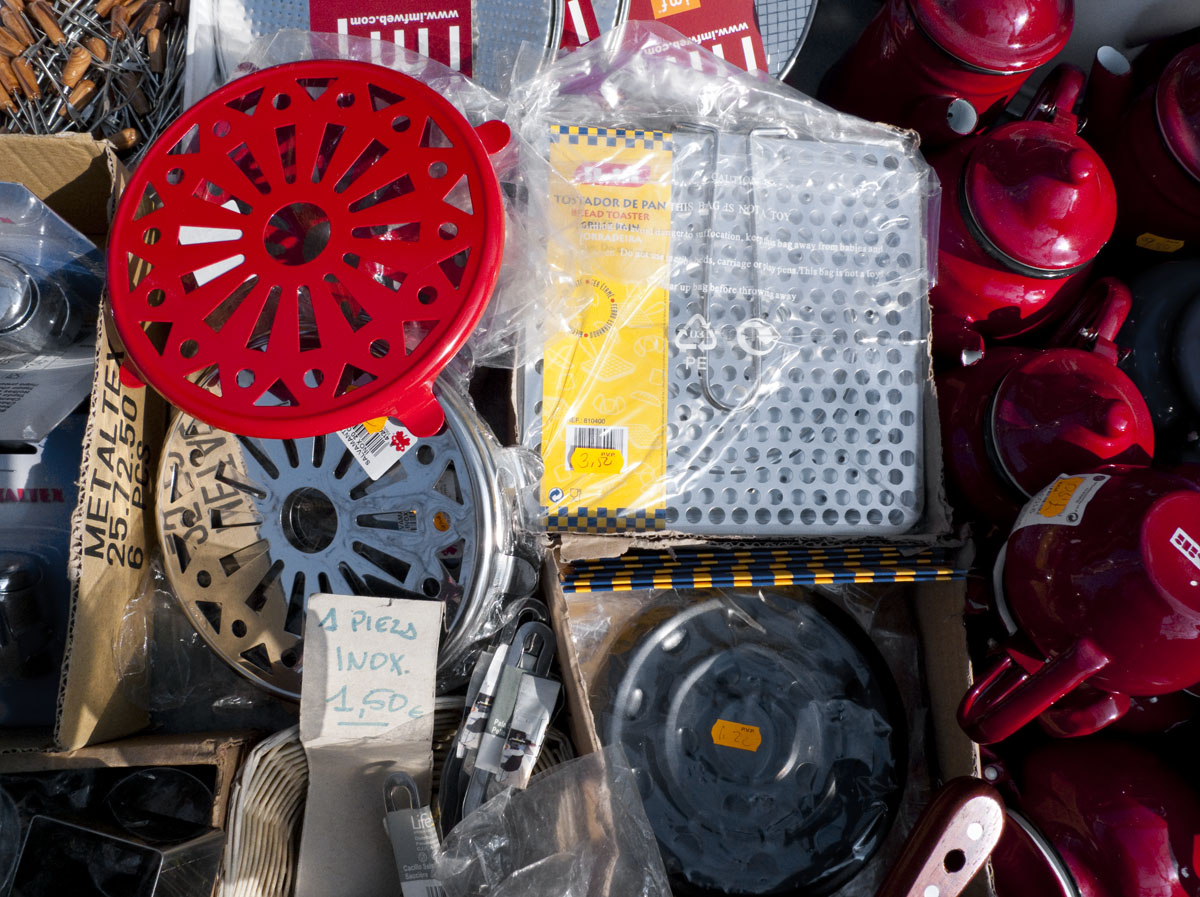
Every Monday, Wednesday, Friday, and Saturday, the calls of spirited vendors rise and fall like contrapuntal melodic lines in the Fira de Bellcaire, Barcelona’s open air flea market. I still haven’t found any rare and unrecognized masterpieces in their heaps of junk, but from time to time I feel the gravitational pull of this bustling arena. Perhaps it is the energy of the market that keeps me returning? More likely, it’s the fortuitous location, an easy fifteen-minute walk from my apartment. There is some fascinating people watching here, not to mention enough random dust-covered clutter to keep a third rate antique store fully stocked for years.

Despite my many ventures into the crowded market, I still feel a bit discombobulated every time I walk in. It’s that frenetic energy and the anticipation of hitting the jackpot. I move through the crowded aisle of ancient LPs, rusted hand tools, and yellowing photographs. I want to get to those vendors who display their wares on large plastic tarps. There you can find some potentially good stuff: chipped porcelain dishes, garish golden statues, bolts of brightly patterned fabric, and of course, carved dark wood headboards. I’ve seen people carry some crazy stuff out of the gate.

But while I enjoy the idea of the hunt, the fact is that I lack both the patience and the talent to be more than an occasional treasure hunter. In the end, I always lose interest in these makeshift stands and find myself in the friendly company of a man who sells kitchenware. Gruff, beard yellowed by an ever-present cigarette, and dressed in blue overalls, his appearance contrasts with his almost delicate, soft voice and encyclopedic knowledge of kitchen equipment. If you get him started on paella pans, you’ll be there for at least 15 minutes. Don’t misunderstand me, I am completely captivated by him and I almost never leave without purchasing something, to the annoyance of the person who will be carrying my suitcase home.

My latest purchase is a stainless steel paella pan. When my mother visited, she mentioned wanting to bring one back to the States. So we paid him a visit, but after he went through a long explanation of paella maintenance (not dishwasher safe), she decided against it. Younger, and less experienced, I purchased one. I don’t exactly regret the purchase, but taking care of the light steel pan is a bit of a pain. The pan has to be thoroughly dried and lightly coated in olive oil after every use to prevent rusting. In the end, this shouldn’t be such a problem, but I am spoiled by American no-stress cookware. I love cooking pots, gadgets, storage containers, spatulas, and wooden spoons. I just hate doing dishes!